
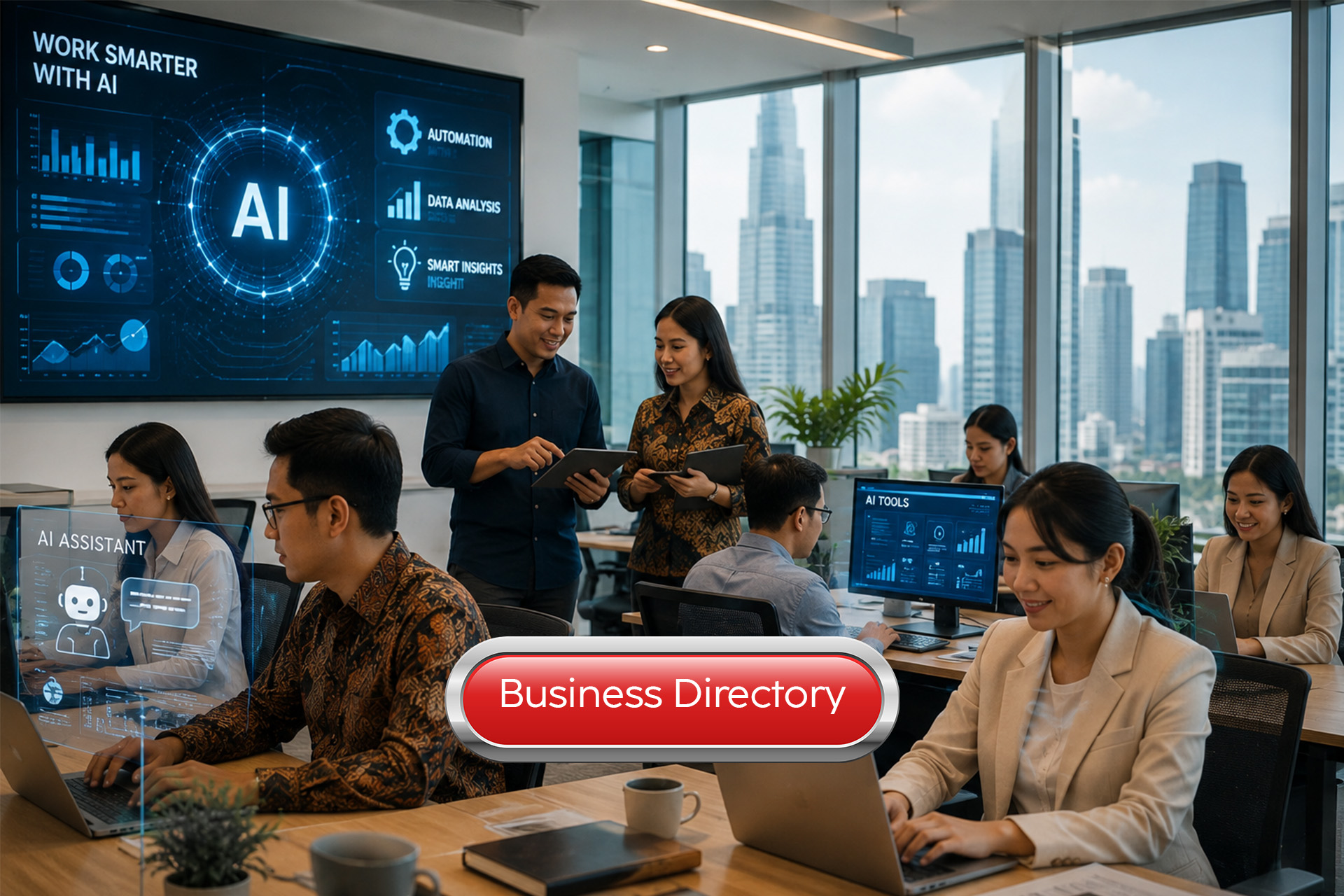
Business Digitalization in Indonesia is moving into a more practical stage. AI is no longer just a technology discussed as something for the future. Indonesian companies are already using it in their daily operations.
Coordinating Minister for Economic Affairs Airlangga Hartarto said an Amazon Web Services (AWS) study found that around 40% of businesses in Indonesia have adopted AI. Released in August 2026, the AWS study also showed that AI adoption among Indonesian businesses had increased from the previous year. Companies are increasingly using the technology to improve productivity, support innovation, and drive growth.
That shift says a lot about how businesses are approaching AI today.
The conversation is no longer simply about whether AI will enter the workplace. Businesses are now asking a more practical question: which tasks should be automated, and where is human involvement still necessary?
That distinction matters. AI can process data in seconds. It can generate reports, identify patterns, and automate repetitive tasks. But business decisions aren’t always that simple. When a decision involves company structure, taxation, employment, regulatory compliance, or legal obligations, human judgment still matters.
Airlangga has also warned that AI has limitations. The technology can make mistakes, choose inefficient approaches, or even produce inaccurate information. That makes human oversight essential.
For companies accelerating their digital transformation, the lesson is fairly straightforward. AI should strengthen business operations, not remove the controls that keep those operations on track.
Business Digitalization in Indonesia Is Becoming More Practical
One of the biggest changes in Indonesia’s AI landscape isn’t necessarily the technology itself. It’s the way companies are beginning to use it.
According to AWS, AI adoption in Indonesia has reached 40%. Businesses already using the technology have reported benefits in areas such as productivity, innovation, and revenue growth. AWS also found that companies are gradually moving beyond experimentation and beginning to implement AI more broadly.
But there’s an important difference between having access to AI and actually getting business value from it.
A company might use AI to create marketing content, analyze sales data, assist customer service, prepare documents, or automate administrative work. These applications can save time.
Still, the results depend heavily on the business processes behind them.
Read also: A 1 GW AI Factory Could Put Indonesia on the Regional AI Map
Consider a company with sophisticated digital tools but an unorganized legal structure. Its financial records may still be inconsistent. Tax reporting might lack a clear process. Employee information could be scattered across multiple files.
The company might even be unclear about whether its business activities match its registered KBLI classification and existing licenses.
In that situation, adding more technology won’t necessarily solve the problem.
It could make things more complicated.
This is where the development of Business Digitalization in Indonesia becomes particularly relevant for foreign companies and investors considering the Indonesian market. Before looking at how AI can improve productivity, businesses need to understand how their operations will function within Indonesia’s legal and administrative environment.
Technology can process information.
Someone still needs to make sure that the information is accurate, the company’s obligations have been fulfilled, and the resulting decisions comply with applicable regulations.
That’s why mature digital transformation shouldn’t begin with the question, “What AI tools can we use?”
A better starting point is, “Which parts of our business need to become more efficient, and which controls must remain in place?”
Strong Foundations Matter for Business Digitalization in Indonesia
There’s a reason AI discussions increasingly involve data quality, human resources, governance, and risk management.
AI depends on the information and processes around it. If the underlying data is inaccurate or the business process is poorly organized, automation won’t magically fix it.
The same principle applies across different areas of a company.
Take accounting, for example. Automation can process transactions and generate financial reports faster. But the underlying records still need to be accurate.
Payroll works in much the same way. A digital system can help calculate salaries, taxes, BPJS contributions, benefits, and other components. Yet the employee data entering the system must remain accurate and up to date.
Tax reporting is another example.
Software can organize information and reduce administrative work. However, determining a company’s tax obligations still requires an understanding of applicable regulations and the specific circumstances of the business.
This is why the growth of AI is actually making strong operational foundations more important, not less.
Companies with organized data, clearly defined workflows, and controlled responsibilities are generally better positioned to benefit from automation.
Companies that automate disorganized processes may simply transfer old problems into a new system.
AWS also highlights strategy, return on investment measurement, and skills readiness as important factors in achieving value from AI. Its findings further point to a shortage of digital talent as one of the challenges businesses face when expanding AI implementation.
For foreign companies entering Indonesia, the challenge can be even more complex.
They need to adapt to the local business environment while meeting administrative and regulatory obligations. Company structure, licensing, employment, payroll, taxation, and reporting all need to work properly before technology can deliver the efficiency businesses expect.
In this environment, humans aren’t competing with AI. They’re helping make sure AI is being used where it actually makes sense.
Keeping Business Digitalization in Indonesia on the Right Track
The rise of AI doesn’t mean every business function should become automated.
Some tasks are highly suitable for technology. Repetitive work is one obvious example. So are processes that rely heavily on structured data and follow predictable patterns.
Other decisions are different. They require judgment, communication, experience, and an understanding of specific circumstances.
Choosing a company’s legal structure, for example, shouldn’t be based solely on an automated recommendation. The same applies when deciding how to expand into Indonesia, assessing tax obligations, structuring employment arrangements, or determining whether business activities meet licensing requirements.
Mistakes in these areas can have consequences that go far beyond an incorrect piece of data. This is why human oversight becomes even more important as businesses become more digital.
The goal of digital transformation shouldn’t be to remove people from business processes. It should be to reduce unnecessary administrative work so people can focus on decisions that actually require judgment.
For companies operating in Indonesia, this also makes the choice of operational partners increasingly important.
Businesses don’t necessarily need to build every function internally. Certain areas can be supported by professional service providers with a strong understanding of the Indonesian business environment.
Bizindo, for example, supports companies with various operational needs that sit behind day-to-day business activities.
For companies entering Indonesia, support can begin with establishing a legal entity and preparing the necessary legal foundations. Once the business is operating, its needs may expand into accounting, payroll, tax reporting, recruitment, and legal compliance.
Companies that need employees in Indonesia without immediately building a large internal HR structure can also use an Employer of Record (EOR) solution. EOR support from Bizindo includes employee management, payroll, and benefits.
This approach allows companies to maintain control over their business activities without having to build every administrative function from scratch.
That’s where technology and professional services can work together.
Digital systems make processes faster and more organized. Experienced professionals provide the judgment needed to ensure those processes remain aligned with business requirements and Indonesian regulations.
What Businesses Should Take Away From Indonesia’s AI Adoption
The 40% AI adoption figure isn’t simply a statistic showing how many Indonesian businesses are using a new technology.
It reflects a broader change in how companies are operating. Businesses are becoming more comfortable with automation. AI is moving into everyday workflows. Digital tools are becoming part of how companies manage information, communicate with customers, and make decisions.
But technology alone won’t determine which businesses benefit most from this transition.
AI can make processes faster.
Data can help management make better-informed decisions.
Automation can reduce repetitive work.
But none of these things replaces the need for a solid business foundation.
Companies still need proper legal structures. They need reliable accounting and payroll processes. They need to meet tax obligations, manage employees, and maintain regulatory compliance.
When those foundations are in place, businesses have much more room to use technology without losing control of their operations.
This is particularly important for foreign companies building or expanding their presence in Indonesia. Combining digital tools with local professional support can make the expansion process more structured and manageable.
So, perhaps the most important question isn’t whether your business is ready to use AI. It’s whether your business has the right foundation to use it properly. Contact Bizindo today!



 20% off today. Whatsapp us!