
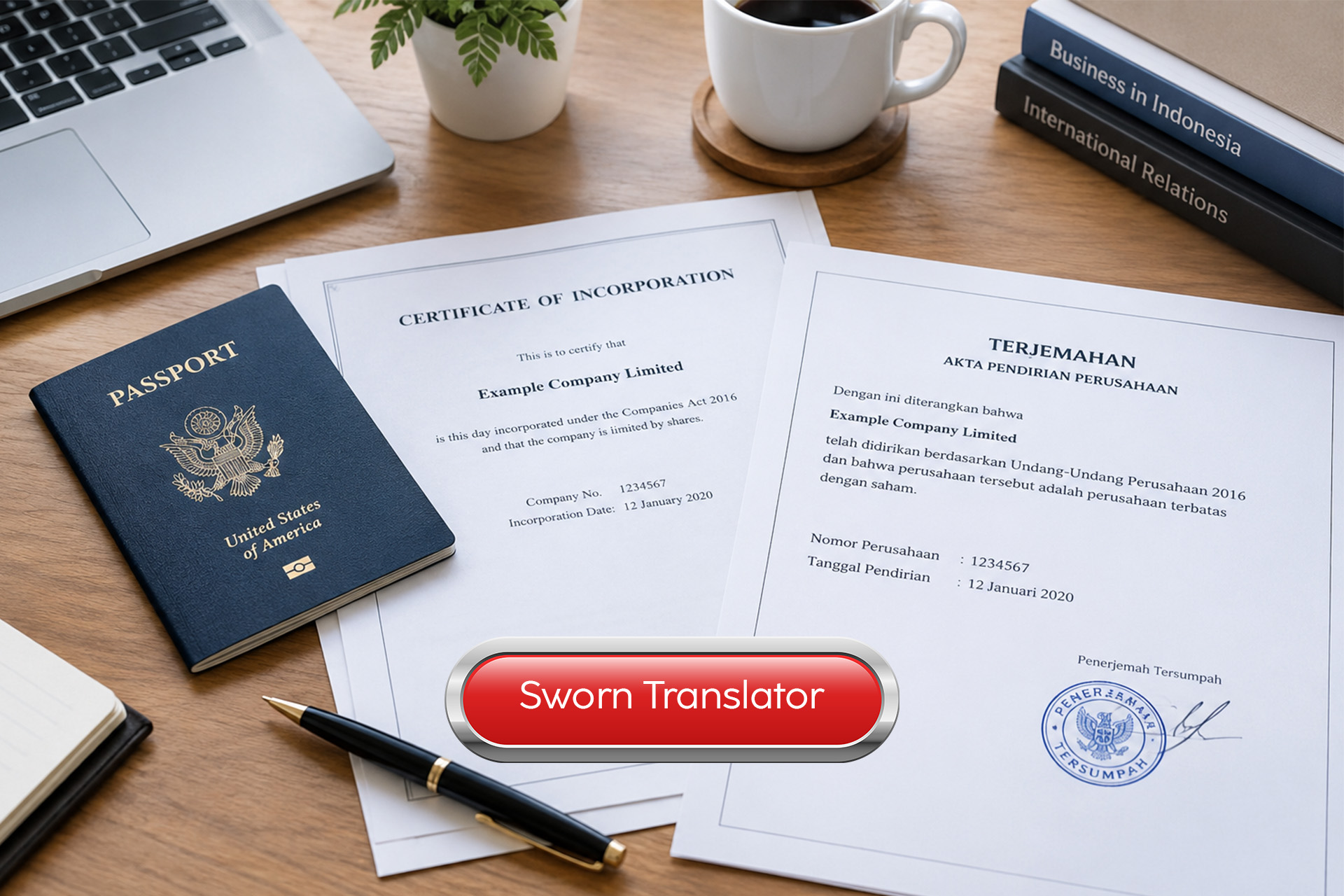
Preparing official documents for immigration, employment, or business registration in Indonesia can involve more than completing application forms and collecting certificates. Documents issued overseas may also need to be translated into a language accepted by the relevant Indonesian authority. A Sworn Translator in Indonesia can help foreign nationals, expatriates, international families, and investors prepare translations for official purposes. Knowing which documents may require this service can make administrative preparations more efficient and reduce the risk of avoidable delays.
Sworn translation is commonly relevant when documents serve as evidence of identity, family relationships, educational qualifications, legal authority, or company status. Examples include marriage certificates for certain family-related immigration applications, academic records for employment or professional procedures, and corporate documents used in business establishment. However, sworn translation is not automatically required for every foreign-language document. The requirements depend on the purpose of the document, its original language, and the institution or authority receiving it.
For foreigners planning to live, work, or invest in Indonesia, checking these requirements early can help clarify which documents need translation and whether additional formalities apply. The following guide covers common document categories, practical considerations when arranging sworn translation, and how professional assistance can support immigration and business-related processes.
Sworn Translator in Indonesia for Birth Certificates, Marriage Certificates, and Family Documents
Personal and family documents are among the records that may require sworn translation when foreign nationals apply for certain visas, residence permits, or other official services in Indonesia. These documents establish identity, marital status, and family relationships. Their contents may be used to verify whether an applicant meets the requirements of a particular immigration category.
Marriage certificates are a common example. Foreign nationals applying for an immigration status based on their relationship with a spouse may need to submit proof of marriage. Birth certificates may also be requested when parents arrange immigration documents for their children. Depending on the circumstances, other records, including divorce certificates or adoption-related documents, may be relevant to a particular application.
Indonesia’s immigration requirements include cases in which marriage and birth documents must be translated into Indonesian by a sworn translator. Certain requirements also provide an exception for documents written in English. This is an important distinction because translation requirements can differ between visa categories and individual applications. Checking the applicable document checklist is more reliable than assuming every foreign certificate must follow the same procedure.
Consider an expatriate relocating to Indonesia with a spouse and children. The family may need to prepare a marriage certificate issued overseas, birth certificates for the children, and other supporting records. If these documents originate from different countries, they may follow different formats or naming conventions. Preparing translations that accurately preserve the original information can help ensure that the documents remain consistent throughout the application process.
Names and personal details deserve particular attention. A person’s name may appear differently across a passport, birth certificate, and marriage certificate because of transliteration, name order, or differences in the issuing country’s documentation practices. A translator should preserve the information contained in the original document rather than make unsupported corrections. Any discrepancy should be reviewed and resolved through the appropriate process before the documents are submitted.
Preparing family documents together can also help identify potential issues earlier. For instance, a discrepancy in a child’s name or a missing supporting certificate may affect the completeness of an application. Although accurate translation cannot guarantee immigration approval, consistent documentation can reduce the likelihood of delays caused by unclear information or requests for additional clarification.
For expatriates arranging a dependent visa or another family-related immigration application, a Sworn Translator in Indonesia can help prepare personal documents when an officially recognized translation is required. Confirming the requirements before ordering the service is equally important, as some documents may already meet the receiving authority’s language requirements.
Sworn Translator in Indonesia for Diplomas, Employment Records, and Professional Qualifications
Foreign professionals considering employment in Indonesia may need to provide documents showing their education, professional qualifications, and work experience. Depending on the position and the applicable administrative process, these records may include university diplomas, academic transcripts, professional certificates, competency records, or letters confirming previous employment. When documents issued overseas need to be submitted to an Indonesian institution, translation requirements should be checked in advance.
A university diploma, for example, identifies the awarding institution and the qualification obtained. An academic transcript provides more detailed information about courses, grades, and academic results. When these documents are used to demonstrate that an applicant has the qualifications required for a role, their contents must be presented accurately. Unfamiliar academic titles and technical terminology should be translated carefully to avoid changing the meaning of the original records.
However, a sworn translation and the recognition of a foreign qualification are separate matters. Translating a diploma does not automatically establish that the qualification is equivalent to an Indonesian degree, guarantee acceptance by an employer, or satisfy all requirements associated with employing a foreign worker. Additional verification or supporting documents may be required depending on the profession, employer, and relevant authority.
Other employment-related documents can present similar challenges. Professional licenses, certificates of competency, reference letters, and employment records may contain specialized terminology that does not have a direct equivalent in another language. A translation that oversimplifies a job title or professional qualification could create confusion about an applicant’s experience or responsibilities. Accurate wording helps maintain the distinction between what a document actually establishes and what an employer or authority must assess separately.
For businesses recruiting foreign professionals, document preparation is also a matter of operational planning. Human resources teams may need to coordinate academic records, employment information, and immigration-related paperwork before a candidate can begin working. Discovering a translation requirement late in the process can complicate recruitment schedules, particularly when several supporting documents must be collected from overseas.
A practical approach is to review the document requirements at the beginning of the recruitment or immigration process. This allows employers and applicants to identify which records need sworn translation, whether originals or additional supporting documents are required, and whether the translated information is consistent across the application. These checks can make the preparation process more organized without assuming that every employment document must be translated in the same way.
A Sworn Translator in Indonesia can assist with academic and professional documents when sworn translation is required. For foreign professionals and companies managing employment-related procedures, translation should be considered alongside the applicable immigration, employment, or professional requirements. The translation itself does not replace any required permit, approval, or qualification assessment.
Sworn Translation for Foreign Company Documents and PT PMA Establishment
Foreign investors entering the Indonesian market may need to prepare corporate documents issued in another country. Depending on the company’s structure and the purpose of the transaction, these records may include certificates of incorporation, company registration documents, articles of association, shareholder records, board resolutions, powers of attorney, or commercial agreements.
Such documents can become relevant when establishing a foreign investment company, commonly known as a PT PMA, or handling subsequent corporate activities. For example, a foreign corporate shareholder may be asked to provide documentation establishing its legal existence and identifying the individuals authorized to represent it. If those documents were issued overseas, the parties involved should confirm whether sworn translation or other formalities are required before the records are submitted.
Corporate documents need particular attention because legal terminology can have consequences for business administration and representation. Terms relating to company ownership, voting rights, directors, shareholders, and authorized representatives may have specific meanings under the legal system in which a document was prepared. Translating these terms inaccurately could create confusion about the responsibilities of a representative or the authority granted by a company.
A power of attorney illustrates why precision matters. The document may define who is permitted to act on behalf of a company, which actions the representative can perform, and whether the authorization is subject to particular conditions. A translation that overlooks these limitations could misrepresent the authority described in the original document. The translation must therefore preserve the original meaning, while the legal validity and acceptance of the document remain subject to the relevant requirements.
The same consideration applies to company registration records and agreements. Investors should not assume that every corporate document issued overseas automatically requires sworn translation. At the same time, an ordinary translation may not be sufficient when the receiving institution requires an officially recognized version. The appropriate requirement should be confirmed with the relevant notary, authority, legal adviser, or other receiving party.
Investors should also distinguish translation from apostille or legalization. Sworn translation concerns the accurate rendering of a document into the required language, while authentication procedures address separate questions concerning the document’s origin, signatures, seals, or official status. Depending on the country where a document was issued and the purpose for which it will be used, additional formalities may apply. Completing a translation does not automatically satisfy those requirements.
Read also: UN Chief Praises Indonesia’s Diversity and Calls for Global Governance Reform
These details can affect the preparation of a PT PMA and related business arrangements. Company establishment often involves coordinating information among shareholders, company representatives, notaries, service providers, and government systems. Differences in company names, incomplete supporting records, or documents that do not meet the receiving institution’s requirements can lead to additional administrative work. Reviewing translation and authentication needs early can help investors prepare a more complete set of documents before moving to the next stage.
For foreign investors establishing a PT PMA or handling corporate matters in Indonesia, a Sworn Translator in Indonesia can help prepare foreign-language documents for official use when required. Coordinating translation with company establishment and business licensing support can also help identify documentation needs as part of the wider business process.
Choosing the Right Translation Service and Preparing Documents Correctly
Identifying the documents that may require translation is an important first step. The next is choosing a service suitable for the document type, language pair, and intended use. Personal certificates, academic records, legal instruments, and corporate documents contain different terminology and formatting conventions. A translation provider experienced in official documents can help preserve important details and maintain consistency with the originals.
Before requesting a quotation, prepare clear copies of the documents and explain their intended use. Whether the translation is for a dependent visa, an employment-related procedure, company establishment, or another administrative purpose, this information helps clarify what is needed. The language required by the receiving institution should also be confirmed before the translation begins.
Several practical checks can help prevent unnecessary revisions:
- Confirm the document requirements with the authority, employer, notary, legal adviser, or institution receiving the records.
- Check whether the original language is accepted or whether a translation into Indonesian or another specified language is required.
- Review names, dates, company details, document numbers, and other identifying information for consistency with the original documents.
- Ask whether apostille, legalization, notarization, or other authentication procedures are also required.
- Confirm the expected turnaround time, delivery format, and whether printed copies are needed.
- Keep the original documents and completed translations available in case further clarification is requested.
Confidentiality also matters when preparing documents for official use. Passports, family certificates, academic records, corporate information, and shareholder documents can contain sensitive personal or business details. Before sending these materials, check how the provider handles submitted documents and use an appropriate channel to share them.
It is also useful to understand the difference between sworn translation, general translation, and interpretation. General translation may be suitable for business correspondence, website content, internal reports, and other materials that do not require a sworn translator. Interpretation is used for spoken communication during meetings, negotiations, or appointments. Sworn translation is relevant when a written document must satisfy the formal requirements of an official process.
Selecting the right service depends on the purpose of the document, not simply the language in which it was written. A foreign-language document may be understandable without translation but still require a particular format for official submission. Conversely, some documents may not need sworn translation if the receiving institution accepts the original version. Checking the requirements first helps avoid spending time and money on a service that is unnecessary or unsuitable.
Careful preparation cannot guarantee approval of an immigration application or business registration. Those decisions remain subject to the applicable requirements and review process. However, accurate translations, consistent supporting information, and early confirmation of document requirements can make the administrative process easier to manage.
Get Sworn Translation Support from Bizindo
Foreign nationals, expatriate families, and international investors often need to coordinate several administrative matters at once. An expatriate family may be preparing supporting documents for a dependent visa while arranging a move to Indonesia. A foreign professional may need to organize academic records for an employment process, while an investor may be preparing corporate documents for a PT PMA. Each situation has its own requirements, making suitable translation support an important part of document preparation.
Bizindo provides Sworn Translator services for official documents, including personal certificates, academic records, legal documents, business agreements, and corporate paperwork. The service can support individuals and companies preparing translated documents for immigration, employment, and business-related administrative purposes. The specific requirements should still be confirmed with the receiving authority before translation begins.
Bizindo’s support also extends to other aspects of establishing and operating a business in Indonesia, including company establishment, business licensing, immigration services, and related corporate administration. This broader range of services can be useful when sworn translation forms part of a larger process, such as preparing documents for a family-related immigration application or organizing foreign corporate records for business establishment.
Whether the requirement involves a marriage certificate, an academic diploma, a power of attorney, or foreign company documents, preparing the appropriate translation at the right stage can help keep administrative matters organized.
Contact Bizindo to discuss Sworn Translator services in Indonesia and determine the appropriate support for personal or corporate documents. With clear requirements and properly prepared paperwork, foreigners and investors can approach their immigration and business administration needs with greater confidence.

 20% off today. Whatsapp us!