
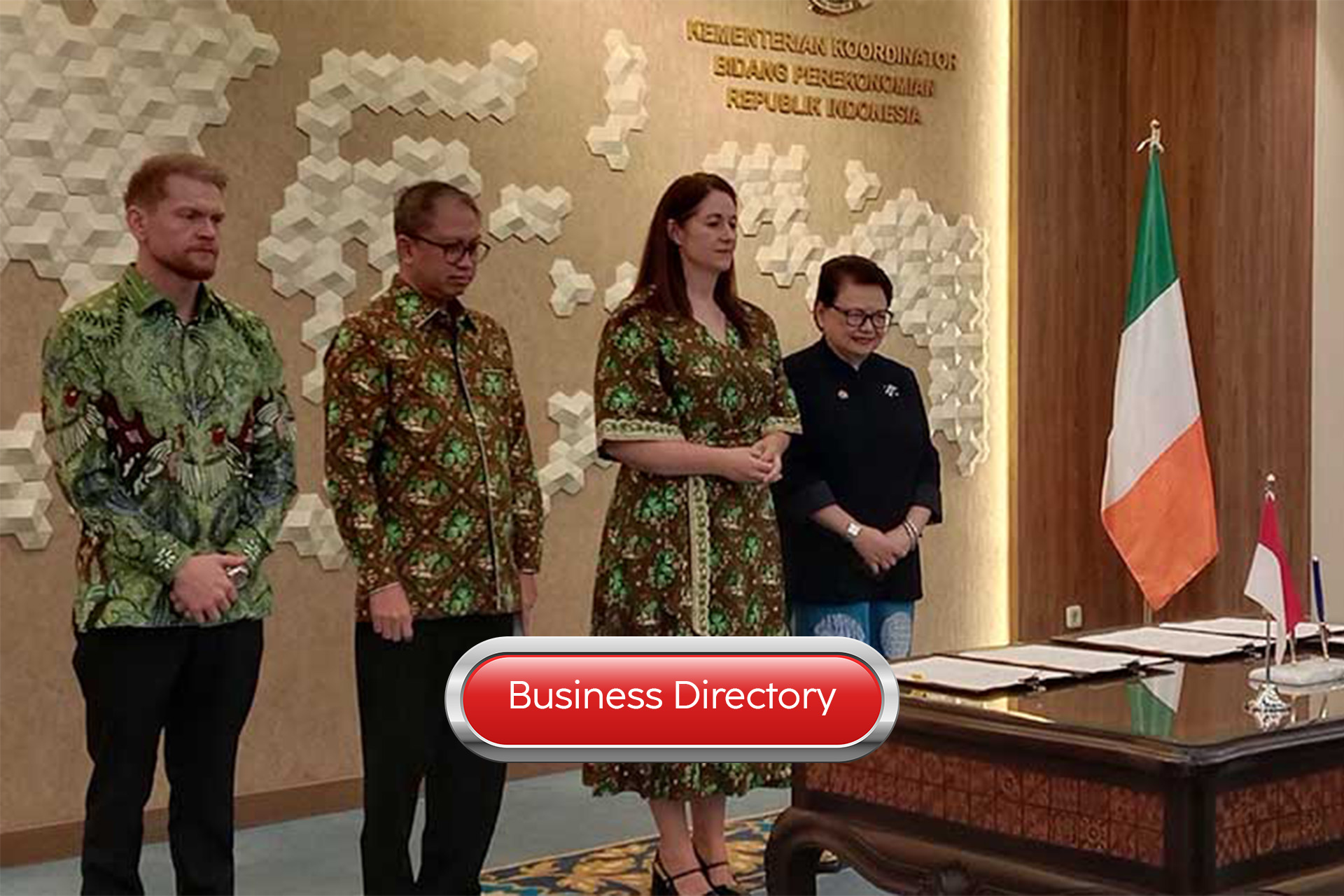
Irish Investment in Indonesia could be entering a new phase after Indonesia and Ireland signed a Letter of Intent (LoI) on the development of economic and business cooperation on Friday, September 4, 2026. The agreement covers several sectors with high growth prospects, ranging from digital technology and artificial intelligence (AI), renewable energy and clean technology, sustainable finance, agri-food and nutrition, pharmaceuticals and healthcare services, to aviation and related services. For the business community, this development signals that the economic relationship between the two countries is beginning to move toward more concrete forms of cooperation.
The momentum coincides with the 42nd anniversary of diplomatic relations between Indonesia and Ireland. Over the past four decades, the relationship between the two countries has developed through trade, investment, education, and people-to-people ties. In terms of trade, its value reached US$228.6 million throughout 2025. From January to July 2026, bilateral trade had reached US$145.5 million, and the government considers this figure to reflect only part of the economic potential that could be developed further.
The government’s statement regarding this potential is important because the latest Indonesia-Ireland cooperation has a somewhat different character. Its focus is on sectors that require technology, expertise, capital, and market access. Indonesia offers a large market and continuously expanding industrial capacity, while Ireland has strengths in technology, expertise, and international business networks. This combination creates room for cooperation that can develop from trade relations into direct investment and the establishment of business activities in Indonesia.
Irish Investment in Indonesia Is Becoming More Open
The signing of the LoI could serve as a starting point for Irish companies to look at Indonesia from a broader perspective. When both governments officially identify the digital sector, AI, clean energy, pharmaceuticals, healthcare, agri-food, and aviation as areas with cooperation potential, the opportunities are no longer limited to import and export activities.
Deputy for Economic Cooperation and Investment Coordination at the Coordinating Ministry for Economic Affairs Edi Prio Pambudi described the document as an important foundation for translating various shared priorities into more concrete cooperation between governments, businesses, and relevant institutions in both countries. The government also sees opportunities for direct investment from Ireland into Indonesia as one form of commitment within the economic relationship between the two countries.
These opportunities become even more interesting when looking at the position of each country. Indonesia has a large population, a growing domestic market, a broad industrial base, and investment needs across various sectors. Ireland, meanwhile, has a strong reputation as a center of technology and innovation in Europe, along with international business networks that can serve as a source of technology and expertise for the Indonesian market.
This complementarity makes the technology sector one of the most promising areas. Ireland has become a base for various global technology companies and has a growing digital ecosystem. That experience can meet Indonesia’s needs as it expands digitalization across business, industry, finance, healthcare, energy, and public services.
The same applies to renewable energy and clean technology. The transition toward a more sustainable economy requires both investment and technology. For companies with solutions in energy, efficiency, low-carbon technology, or supporting infrastructure, Indonesia offers a market with increasingly diverse needs.
The pharmaceutical and healthcare sectors also have significant room for growth. Ireland’s capabilities in pharmaceuticals and biopharmaceuticals can be matched with the needs of Indonesia’s large population, which continues to require greater access to healthcare products and services.
From a business perspective, the significant gap between the current state of economic relations and the potential now being developed is itself part of what makes the opportunity interesting. Trade valued at US$228.6 million in 2025 certainly provides an indication of the scale of the relationship that already exists, but it is not enough to capture the opportunities that could emerge when cooperation expands into higher value-added sectors.
The government itself has emphasized that the economic relationship between the two countries needs to be viewed based on its future potential, rather than simply its current size. This means Irish Investment in Indonesia could very well grow as projects, business partnerships, technology transfers, and the presence of Irish companies in the Indonesian market increase.
The development of Indonesia’s relationship with the European Union also provides additional context. The Indonesian government is currently overseeing the final stages of the IEU-CEPA, which is intended to strengthen market access, trade, and investment relations with the European Union. The government is targeting implementation of the agreement in early 2027 after the signing and ratification stages are completed.
With Ireland’s position as part of the European Union as well as a business and technology hub in Europe, stronger bilateral relations between Indonesia and Ireland could have strategic relevance for companies seeking to make Indonesia part of their expansion strategy in the region.
The Digital Sector Opens Major Opportunities for Irish Investment in Indonesia
Digital technology and AI are among the most prominent sectors on the Indonesia-Ireland cooperation agenda. The government sees the strength of Ireland’s digital ecosystem as an asset that can provide added value for Indonesia, particularly in technology development and connectivity with global business networks. The government has also stated that Ireland’s digital market could reach approximately €300 billion.
This figure demonstrates the importance of the digital ecosystem in the economic relationship between the two countries. However, its strategic value for Indonesia is not simply about the size of Ireland’s digital market. More relevant is access to technology, industry experience, corporate networks, and human resources that can support business development in Indonesia.
Irish companies engaged in software, AI, cybersecurity, data, digital services, business technology, or industrial solutions may have various options when entering the Indonesian market. Expansion does not always have to begin with investment in large production facilities. A business presence can be established through a local company, operational office, partnerships, digital service provision, technology partnerships, or the development of service centers or regional functions.
Read also: A 1 GW AI Factory Could Put Indonesia on the Regional AI Map
This makes the Indonesian market attractive for technology companies seeking growth in Southeast Asia. A large population and continuously increasing digitalization are creating demand for technology solutions across various industries. Companies that can adapt their products to local needs may have broader opportunities for growth.
Clean energy has a similar character. Technology and financing can drive projects that support the energy transition. As intergovernmental cooperation creates greater opportunities, foreign companies can explore areas such as technology provision, project development, engineering services, consulting, and various supporting services.
In the pharmaceutical and healthcare sectors, opportunities may emerge through distribution, product development, health technology services, research collaboration, and direct investment. Meanwhile, in the agri-food and nutrition sector, opportunities may arise through food technology development, productivity improvements, product innovation, and supply chains.
The diversity of sectors included in the LoI agenda shows that business opportunities between the two countries do not depend on a single industry. This is important because the more sectors that are opened up, the greater the likelihood that Irish companies will find business models that align with their capabilities when entering Indonesia.
However, market opportunities only become real investments when companies can turn their expansion strategies into business structures that can operate in Indonesia. This is where companies need to start thinking about more technical questions. What form of business is required? What business activities will be conducted? Which KBLI classification is appropriate? What licenses are required? How will taxation be managed? Does the company need to recruit local employees or bring in specialists from Ireland?
These questions show that entering a new market requires preparation to move alongside the investment decision. The sooner companies map out these requirements, the easier it becomes to translate cooperation opportunities into actual business activities.
Business and Tax Preparation Are Key to Irish Investment in Indonesia
Irish companies that ultimately decide to establish a business presence in Indonesia will face a different stage from simply conducting cross-border trade transactions. Once activities begin to take place permanently in Indonesia, companies need to determine the business structure, licensing, taxation, workforce, and operational requirements that align with their business models.
Choosing the appropriate entity is one of the initial decisions. Companies need to determine whether they require a PT PMA, representative office, or another form of business presence based on their planned activities. The selection of the appropriate KBLI classification also needs to be handled carefully because the business sector is directly related to the types of licenses and scope of activities a company can undertake.
This becomes increasingly important for the sectors included in the Indonesia-Ireland cooperation agenda. Technology, healthcare, pharmaceuticals, energy, and professional services companies may have different regulatory requirements. Using a structure that does not align with business activities can create problems when a company begins expanding, recruiting employees, or broadening its services.
Taxation is also receiving particular attention in the latest developments in bilateral relations. On September 4, 2026, the Indonesian government stated that it is pursuing a Double Taxation Agreement (DTA) with Ireland. Indonesia currently does not have a DTA with Ireland, and the government hopes that such an agreement can improve the efficiency of trade relations and facilitate various business interests between the two countries.
The government also views Ireland as one of the countries that can be utilized as a gateway to the European market. Therefore, tax discussions in Indonesia-Ireland relations have a broader dimension than corporate reporting obligations. Cross-border transaction structures, investments, and business relationships between entities could become increasingly important as the economic relationship between the two countries develops.
Companies entering Indonesia also need to prepare tax and accounting administration from the outset. Record-keeping, reporting, payroll, and compliance with corporate obligations need to operate alongside business growth. This is particularly relevant for foreign companies that do not yet have a local team and are unfamiliar with Indonesia’s administrative systems.
Workforce requirements are another important consideration. Companies may need a combination of local employees and specialists from Ireland or other countries. When expatriates are placed in Indonesia, companies need to ensure that their visas and residence permits match their intended purposes and activities. At the same time, recruiting local employees creates requirements related to payroll, employment administration, and compliance.
Therefore, Irish Investment in Indonesia needs to be prepared from two perspectives at once. Market potential and sector opportunities must be understood, but operational and legal readiness must also be established from the beginning. For foreign companies, the challenge is often not finding an opportunity, but ensuring that the opportunity can be implemented without creating administrative obstacles later on.
Bizindo can serve as a local partner for Irish companies evaluating or preparing for business expansion into Indonesia. Through its Company Establishment services, Bizindo assists foreign companies with establishing a PT PMA as well as business structure and KBLI-related requirements. Business Licensing support is also available to help companies prepare the permits required for their business activities.
Once the company begins operating, its needs may expand to Accounting and Tax Reporting to support financial administration and tax obligations. For companies that need local employees, Bizindo also provides Recruitment and Employer of Record services as part of its operational and workforce management support.
For companies bringing founders, management, technical specialists, or other professionals from Ireland to Indonesia, Immigration Services can support visa and KITAS requirements based on the activities they will undertake. Expat Relocation can also support expatriates as they relocate and adjust to living and working in Indonesia.
The cooperation between Indonesia and Ireland is still in the process of building its foundation. However, the sectors selected point to a fairly clear direction. Digital technology, AI, clean energy, sustainable finance, agri-food, pharmaceuticals, healthcare, and aviation are areas that have the potential to grow through investment and business partnerships.
With bilateral trade having reached US$145.5 million in just the first seven months of 2026, and the government openly recognizing the greater room for direct investment, the Indonesia-Ireland economic relationship has the potential to grow well beyond its current scale.
For Irish companies considering Indonesia as a new market, this momentum could be an appropriate time to begin conducting a market assessment while preparing the foundation for their business presence. As investment opportunities begin moving from bilateral discussions toward concrete projects and commercial activities, corporate structure, licensing, taxation, workforce, and immigration requirements will become important parts of execution.
With the right preparation and support from a local partner that understands Indonesia’s business environment, companies can more easily translate Indonesia-Ireland cooperation opportunities into a business presence that is ready to operate and grow in Indonesia.



 20% off today. Whatsapp us!